
Biofilm in Poultry Water Lines: Why It Cuts Intake
Biofilm can cut poultry water-line flow up to 80%, starving birds and blunting vaccines dosed in water. Why chlorine flushes don't hold — and what works.
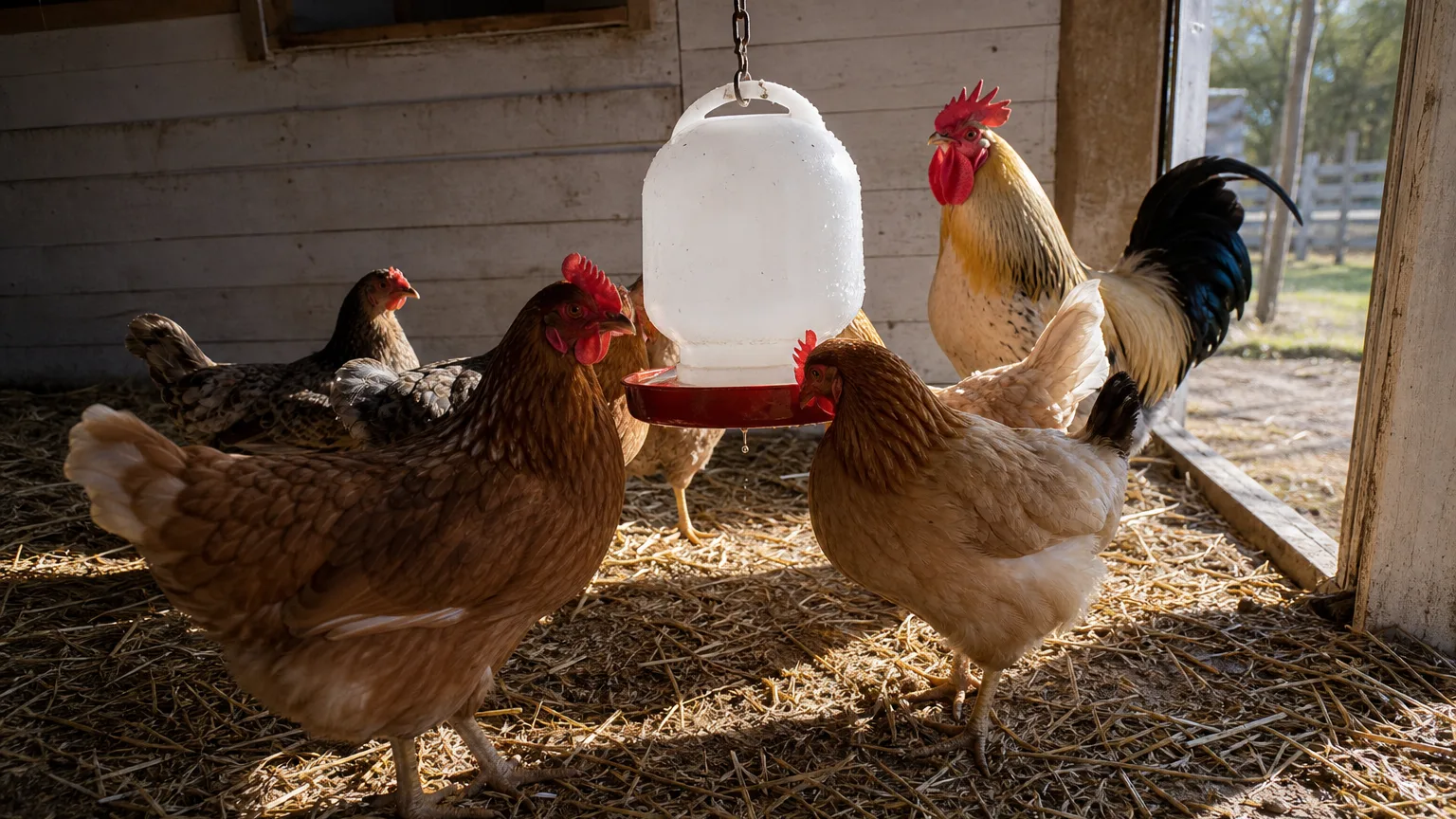
Your birds aren't drinking enough, and you probably don't know why. Heavy biofilm in poultry water lines can cut water flow by 70–80%, and that alone is enough to drag down intake and growth across the whole house — long before you'd ever spot a problem by eye (The Poultry Site).
Here's the thing about biofilm. It doesn't announce itself. No dramatic die-off, no obvious stench, nothing that trips an alarm. It just sits there, quietly narrowing the pipe from the inside, and by the time you notice slower drinker recovery or patchy weight gain, the slime's had weeks to build a small city on the walls of your line. I've talked to enough producers who've chased "mystery" performance dips for a full flock cycle before someone finally pulled a section of pipe and found the culprit coating the inside like wet felt.
This piece is about what that slime actually is, why your chlorine flush keeps failing to hold, and what a realistic hygiene routine looks like — one built around cleaning the line, not just nuking it and hoping.
What biofilm actually is — and how fast it forms in a warm drinker line
Biofilm is a community. Bacteria land on a wet surface, and instead of drifting on, they park themselves down and start secreting a slimy matrix — a mix of sugars, proteins, and DNA — that glues them to the pipe wall and to each other. Once that matrix is established, it acts like a fortress wall. New bacteria join in, debris gets trapped, and the whole structure thickens layer by layer.
It doesn't need much encouragement. A handful of conditions make biofilm form faster and grow thicker: low flow rate, warm water temperature, low water pressure, available nutrients (feed dust, mineral residue, organic matter), and even the pipe material itself — some plastics harbor it more readily than others (ScienceDirect).
Think about what a poultry house actually delivers on most of those fronts. Warm ambient temperature for brooding. Water sitting in stretches of line between drinking bouts, sometimes for hours. Vitamin and mineral supplements dosed through the water — which is great for the birds and also, unfortunately, great for bacteria looking for a meal. Low-flow dead-end sections near the end of a line, or wherever a drinker valve restricts flow. It's practically a recipe.
That's why "we flushed it last month, it should be fine" doesn't hold up. Biofilm isn't something you knock out once. Under the right warm, low-flow, nutrient-rich conditions, it's rebuilding from day one.
How biofilm strangles water intake — and why that hits feed intake and growth
Picture the inside of a water line as a garden hose. Now picture that hose slowly filling in with a gel-like coating until the usable diameter is a fraction of what it was. That's biofilm in a nipple line, and it's exactly why flow rate collapses.
A blocked or restricted nipple drinker doesn't just annoy the bird — it changes behavior. Chickens are creatures of habit around water access; when a nipple delivers a weak trickle instead of a clean drop, birds spend less time drinking and more time waiting or giving up. Multiply that across a house and you get measurably lower water intake, which drags feed intake down right behind it, because birds that aren't drinking well don't eat well either. The end result is slower, patchier growth across the flock (WATTAgNet).
Let's put a number on it, because "lower growth" is easy to wave off until you see the math. Say a header tank on a 20,000-bird broiler house is designed to deliver roughly 20 liters a minute to the drinker lines under normal conditions — a reasonable number for a house that size at full stocking. Heavy biofilm cutting flow by 70–80% doesn't leave you with a slightly slower system. It leaves you with 4 to 6 liters a minute trying to service the same 20,000 mouths. That's not a system running a bit behind; that's a system that physically cannot keep up during peak demand — first thing in the morning, after lights-on, during a heat spike. Birds queue for water they can't get fast enough, drink less overall, and the growth curve bends downward in a way that shows up on the scale at the end of the week, not on any alarm panel today.
And this is the part that stings: none of it shows up as a discrete "event." No mortality spike, no obvious sick day. Just a flock that converts a little worse than it should, week after week, for reasons that never get traced back to a pipe.
The three costs producers don't see coming
Reduced flow is the cost you can eventually measure. These three are the ones that hide in plain sight.
It shelters Salmonella and E. coli
Biofilm isn't neutral slime. It's a physical harbor for pathogens — the matrix traps and protects bacteria including Salmonella and E. coli, turning your water line into an ongoing contamination source rather than a one-time risk (ScienceDirect). Every time a bird drinks from a fouled nipple, it's not just getting water. It's getting whatever the biofilm decided to shed that hour.
It quietly wrecks your water-line vaccines and meds
This one costs real money and nobody notices until results come back odd. When you dose vaccines or medications through the drinking system, biofilm can neutralize a portion of what you're delivering before it ever reaches the bird — meaning your flock may be under-dosed despite you following label rates to the letter (Food Safety Magazine). You did everything right on paper. The line ate part of the dose anyway.
It makes your sanitizer look like it's failing
Here's a frustrating one: you sanitize on schedule, and biofilm still comes roaring back by the end of grow-out — sometimes re-establishing at levels above 4 log cfu/mL despite consistent sanitation efforts (ScienceDirect). It's tempting to conclude your sanitizer is junk or your technique is off. Usually neither is true. The real issue is that biofilm cells are 10 to 1000 times less susceptible to antimicrobials than free-floating bacteria in open water (Food Safety Magazine). You're not fighting bacteria. You're fighting bacteria wrapped in armor.
Why the chlorine/peroxide flush never seems to hold (the "oxidizer treadmill")
If you've run a chlorine or peroxide flush and felt like you were back to square one within a week, you weren't imagining it. Documented testing on PVC coupons in clean potable water showed biofilm regrowing within 3 to 7 days after a chlorine/peroxide/PAA treatment (Scientific Reports).
Three to seven days. In clean potable water — not even a working farm environment with feed dust and mineral supplements adding fuel to the fire.
That's the treadmill. You flush, you sanitize, biofilm regrows almost immediately because a handful of protected cells always survive the oxidizer — remember, they're up to a thousand times harder to kill in that state — and those survivors just rebuild the matrix from scratch. You flush again next week. Nothing about the underlying surface changed; you just reset the clock on the same cycle.
It's not that chlorine and peroxide don't work. They do, against exposed, planktonic bacteria in the open water column. The problem is the built-up structure on the pipe wall itself. An oxidizer passing through for twenty minutes once a week isn't a long enough, strong enough contact to strip a mature biofilm layer down to bare plastic. It knocks the surface off, maybe kills what's exposed, and leaves the base intact to reseed the whole thing.
If you've been increasing your chlorine concentration or flushing more often and still seeing the same slime reappear, that's the mechanism you're up against. It's not a dosing problem. It's a structural one.
Clean first, sanitize second — the order most people get wrong
Here's the step almost everyone skips, and it's the single biggest reason sanitizing programs underperform: you have to physically remove the biofilm before you sanitize, not the other way around (Poultry Innovation Partnership).
Sanitizing a line that's still coated in biofilm doesn't clean it. It sloughs contaminated material loose and pushes it downstream — straight toward the drinkers your birds use every day. You've essentially just redistributed the problem, and possibly made short-term water quality worse right when the birds are relying on it.
The correct sequence looks like this:
- Depressurize and drain the line completely.
- Run a descaler or acid-based cleaner through the system to break down mineral scale and loosen the biofilm's grip on the pipe wall — this is the physical/chemical removal step, and it's not optional.
- Flush thoroughly with clean water until the line runs clear, repeating the cleaning pass if the water still looks cloudy or debris-laden.
- Only then sanitize, once the pipe surface is genuinely clean and there's nothing left for the sanitizer to just disturb and redistribute.
- Flush again before birds go back on the line.
Skip step 2, and step 4 is mostly theater. It'll smell like you did something. It won't have done much.
Sterilize vs. colonize — a different way to think about a water line
Here's where I'll level with you, because this section could easily turn into a sales pitch and I'd rather it not.
Everything above is about chemical sanitation, and chemical sanitation has a structural ceiling: it's a kill event. It clears the field for a few days, and then the field refills, because bacteria are opportunists and an empty pipe surface is just real estate waiting to be claimed by whoever gets there first.
The idea behind probiotic dosing — competitive exclusion — is to make sure the "whoever gets there first" is something benign. Multi-strain, spore-forming Bacillus bacteria, dosed regularly through the water, colonize the same pipe and drinker surfaces that pathogenic biofilm would otherwise claim. If beneficial bacteria already occupy that space, there's less surface and fewer nutrients left for harmful biofilm to re-establish on.
That's the logic behind Sanitify's Probiotic Animal Drinking Water Cleaner, 5L (€299, list €349) — free from antibiotics, hormones, and chemical biocides, using Bacillus strains classified under EU rules as safe feed-additive organisms, biodegradable and safe for slurry, made in Estonia. It's not a chlorine substitute you dose once a month and forget. It's an ongoing presence in the line.
I want to be straight about what this can and can't claim. It helps reduce harmful bacteria and helps prevent pathogenic biofilm from re-establishing; it also supports gut microbiome balance in the birds drinking it. It does not kill all pathogens, it doesn't eliminate E. coli or Salmonella outright, and it isn't a cure or prevention for any disease. Competitive exclusion is a real, published mechanism, but the evidence for exactly how it performs across the full range of real farm water systems — different pipe materials, different climates, different flock densities — is still developing. Anyone who tells you a single product solves biofilm for good is selling you something other than the truth.
The honest framing is this: don't sterilize, colonize. Use physical cleaning and sanitation to deal with an existing fouled line. Use ongoing probiotic dosing as the maintenance layer that makes it harder for pathogenic biofilm to get its foothold back once you've cleared it. One without the other leaves a gap.
A practical poultry water-line hygiene routine
Here's how the pieces fit together into something you can actually run week to week.
Daily — Dose probiotic cleaner into drinkers at 10ml per 100L of drinking water. This is the maintenance dose, keeping beneficial bacteria present in the water your birds are actually consuming.
First 7 days of a new flock or after a full clean — Double the daily dose to help the beneficial colony establish itself quickly, before pathogenic organisms get a chance to move in on a freshly cleaned surface.
Monthly (or at the start of each flock cycle) — Run a full line flush: depressurize, descaler/acid clean to strip built-up biofilm and scale, flush clear, then dose the line at 50ml per 500L as part of the monthly maintenance flush.
Between flocks — This is your best opportunity, because the line is empty and there's no bird welfare tradeoff to worry about. Do the full clean-then-sanitize sequence from the section above, properly, every single turnaround. Don't skip it because the last flock "seemed fine."
Ongoing monitoring — Check flow rate at the far end of each line weekly, not just at the header. A weak nipple at the end of a run is often your first real warning sign, long before anything else looks off.
None of this requires new plumbing or a big capital outlay. It requires consistency — the same reason chlorine flushes fail isn't a chemistry problem, it's a "we did it once and moved on" problem.
How to tell your lines are already fouled
A few signs worth walking the house for, especially if you haven't pulled a line apart in a while:
- Nipple drinkers dripping slowly or requiring more pecks to release water than they used to
- Visible slime or a slippery film when you disconnect an end cap or drinker
- Discoloration inside clear sections of line — yellowish, brownish, or cloudy residue clinging to the wall
- Uneven bird distribution around drinker lines, with birds crowding certain nipples and avoiding others
- A flock that's eating on schedule but growth curves are lagging without an obvious health explanation
- Water that tests fine at the source tank but tastes or smells "off" by the time it reaches the far end of a long run
If you're seeing two or more of these, it's worth pulling a section of line and looking with your own eyes rather than guessing.
FAQ
How do I clean biofilm out of chicken water lines?
Depressurize and drain the line, then run an acid-based descaler or dedicated line cleaner through it to physically break down mineral scale and loosen the biofilm matrix from the pipe wall. Flush with clean water until it runs clear — repeat the cleaning pass if it doesn't — and only sanitize after that. Cleaning before sanitizing matters because sanitizing a still-fouled line just pushes contaminated slime downstream toward your drinkers (Poultry Innovation Partnership).
What kills biofilm in poultry drinkers?
Nothing kills it reliably on its own, which is the uncomfortable truth. Chlorine, peroxide, and peracetic acid sanitizers do kill exposed bacteria in the water, but biofilm cells embedded in the matrix are 10 to 1000 times less susceptible to those antimicrobials than free-floating bacteria (Food Safety Magazine), so a sanitizer pass alone rarely clears a mature biofilm. Physical removal (descaling and flushing) has to come first; sanitizing afterward, and ongoing probiotic dosing to occupy the surface once it's clean, are what actually keep it from rebuilding.
Why is there slime in my poultry water lines?
That slime is a bacterial colony that's attached itself to the pipe wall and built a protective matrix around itself. It forms fastest under warm temperatures, low flow rate, low water pressure, and where nutrients — feed dust, mineral residue, vitamin supplements — are available for bacteria to feed on (ScienceDirect). A poultry house's warm environment and dead-end sections of drinker line make near-ideal conditions for it.
How often should poultry water lines be flushed?
At minimum, flush and fully clean-then-sanitize your lines between every flock, when the house is empty and there's no welfare tradeoff to consider. Within a flock cycle, a monthly full line flush with descaling is a reasonable baseline, paired with daily low-dose probiotic maintenance to keep pathogenic biofilm from re-establishing between those full flushes. Given that regrowth on a clean surface has been documented within 3 to 7 days after sanitizing (Scientific Reports), treating this as a one-and-done task at the start of the flock isn't going to hold up.
Where to go from here
Biofilm isn't going to announce itself, and a single flush isn't going to solve it for the whole flock cycle. If you want to go deeper on water hygiene fundamentals for poultry specifically, our poultry water care hub walks through the broader picture, and the animal water care hub covers hygiene practices across species. If you're curious about the research behind probiotic water treatment more generally, we've also written up a study on Bacillus fermentation for water purification and habitat hygiene in livestock.
And if you want to try the maintenance-layer approach yourself, the Probiotic Animal Drinking Water Cleaner, 5L is there, backed by a 30-day money-back guarantee if it's not fitting into your routine the way you'd hoped. No pressure. Just clean lines, one flock at a time.